
Introduction
In decentralized infrastructure networks, one of the most challenging governance paradoxes is this: How do you respond rapidly to existential threats without undermining the very decentralization you’re trying to protect?
When a smart contract vulnerability is discovered, or a treasury faces an unexpected liquidity crisis, there’s often no time for the 7-14 day voting periods that ensure democratic legitimacy. Yet giving any single entity unchecked emergency powers risks creating precisely the kind of centralized control that blockchain governance aims to eliminate.
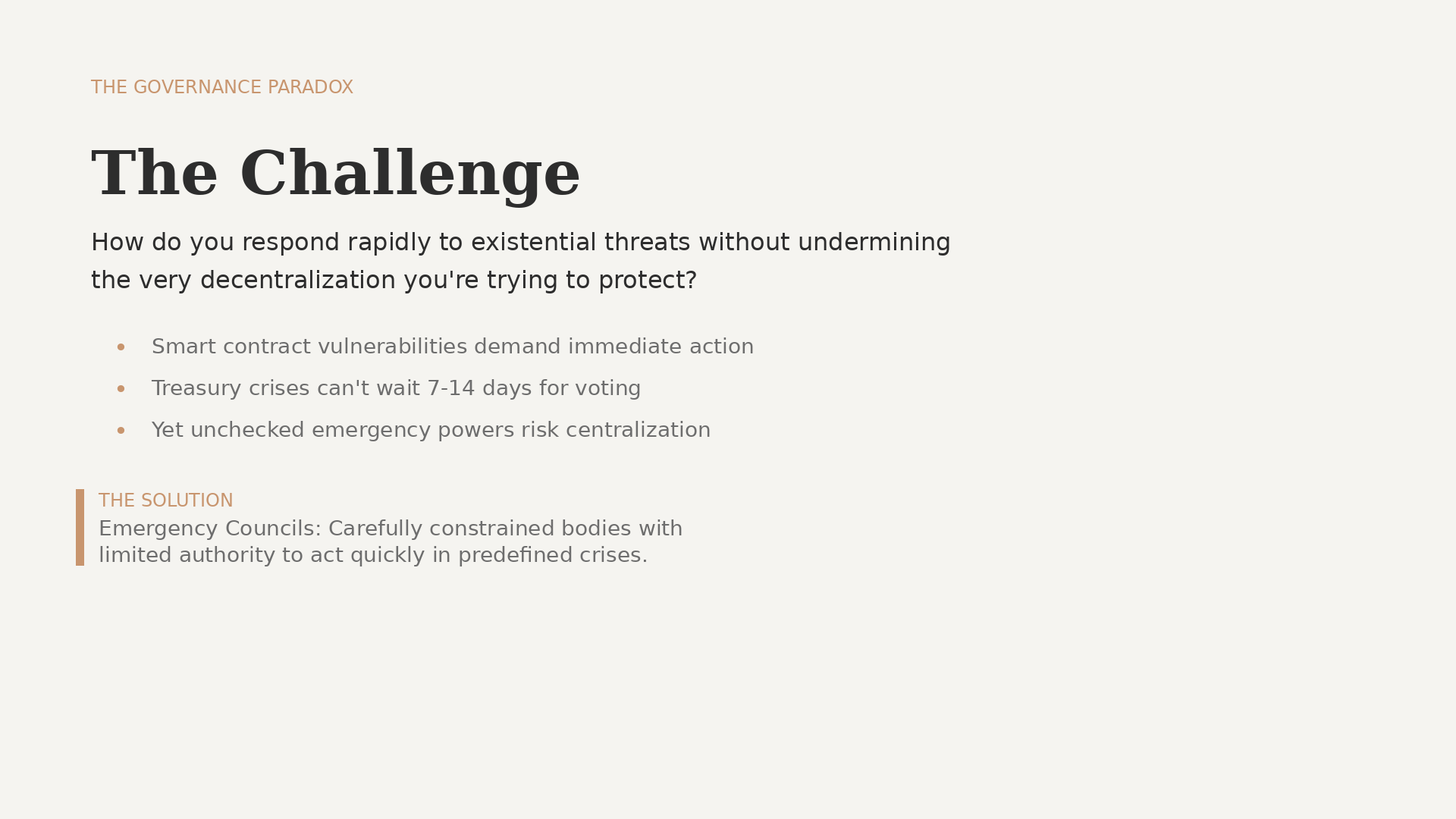
The solution emerging across DePIN networks is the Emergency Council, a carefully constrained body with limited authority to act quickly in predefined crisis scenarios. But how do you design such a mechanism without creating a back door to centralization?
Let’s examine three different approaches: Beamable Network’s implemented governance structure, a proposed but not-yet-implemented Emergency Council design for Beamable, and how established DePIN networks Helium and Akash handle emergency situations.
Beamable Network’s Implemented Governance
Beamable Network’s actual governance takes a Council-centric approach to emergency management, with a Council composed of core executive team members holding substantial powers during the network’s early phase.
Key Features:
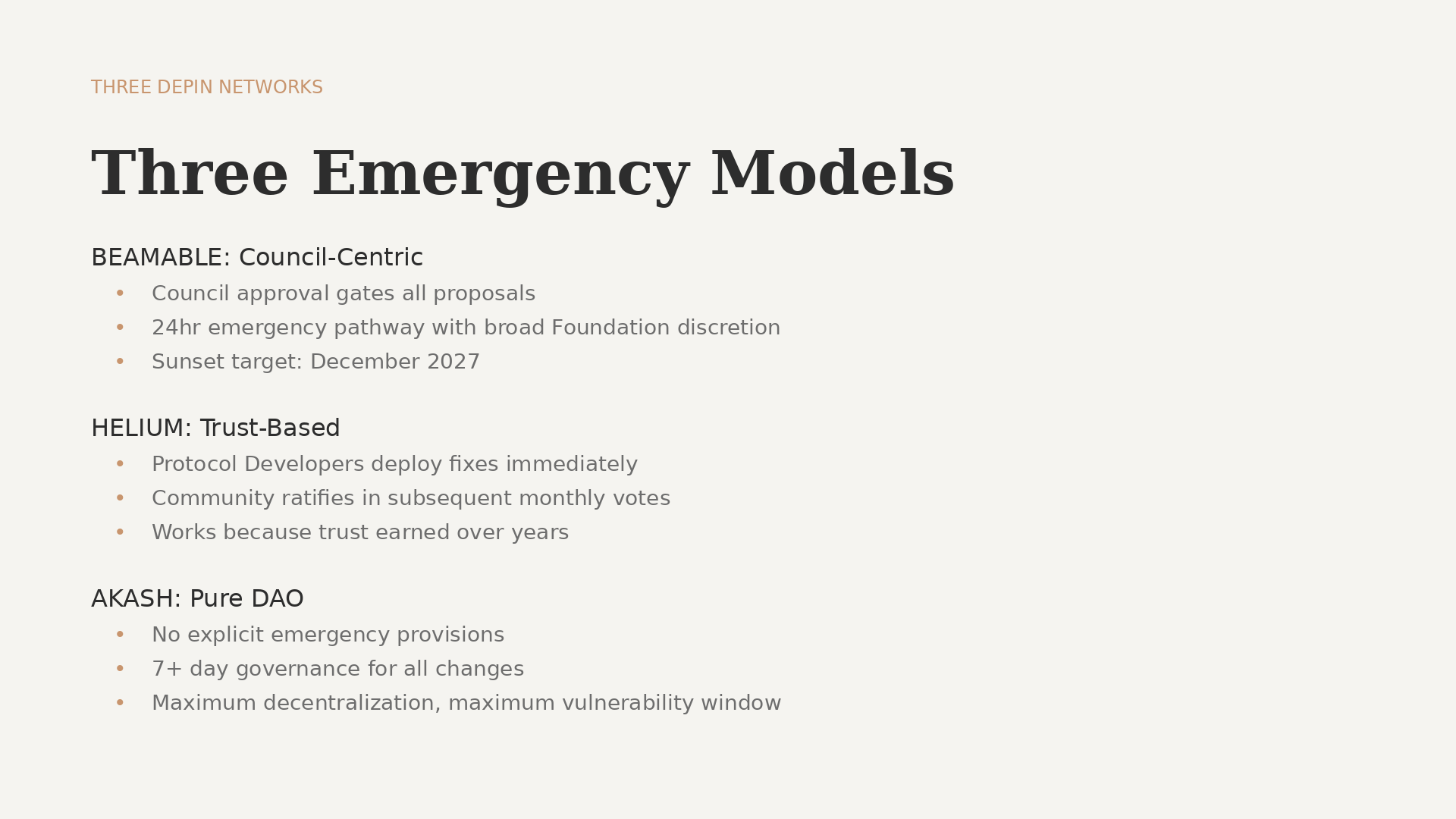
Council Approval Gating: No proposal advances to a vote without Council approval; Council can review, block, or override any proposal
Emergency Proposals: Can bypass commenting periods with only 24-hour minimum notice, but still require Council approval and community voting
Foundation Discretion: Broad authority to refuse implementation of decisions that “endanger regulatory compliance” or “impose unreasonable risk”
Phased Decentralization: Council powers intended to diminish over time with target end date in December, 2027
Assessment: This approach prioritizes network stability and legal safety over immediate decentralization. For a network handling gaming infrastructure , where downtime directly impacts game studios and millions of players, this conservative stance makes sense. However, Beamable’s governance is fundamentally not decentralized during its crucial early years, with Council holding veto power over everything and token holder agency largely symbolic until 2027+. The explicit sunset provisions prevent permanent centralization, and the clear authority structure reduces confusion during crises.
Beamable Network’s Proposed Emergency Council Design
The protocol proposed a more sophisticated Emergency Council structure for eventual adoption. This design offers insights into what a more balanced emergency governance system might look like.
Key Features:
Rotational Membership: Three-member council (CEO, Director, COO) with staggered 6-month terms after initial seeding
Tightly Scoped Authority: Emergency powers limited to six predefined scenarios (financial emergencies, security incidents, network performance crises, node supply emergencies, regulatory response, strategic partnership emergencies)
Strict Spending Caps: Maximum 0.5% of Treasury per emergency instance, requiring unanimous agreement
Mandatory Accountability: 24-hour post-action reporting, quarterly assessments, annual reconfirmation votes, all decisions on-chain with cryptographic signatures
Operational Constraints: Must convene within 4 hours, actions limited to “minimum necessary,” members must recuse themselves from conflicts
Assessment: This proposed design attempts to thread the needle between speed and decentralization with specific crisis scenarios preventing scope creep, multiple accountability mechanisms, and rotational membership preventing power concentration. However, its complexity explains why it wasn’t implemented at network genesis. The unanimous requirement could cause deadlock in genuine crisis, four-hour convening may be too slow for security incidents, and during a network’s vulnerable early days, simpler authority structures may be more practical.
Helium Network’s Trust-Based Emergency Response
Helium, one of the largest and most established DePIN networks, has evolved its emergency governance through hard-won experience. Their approach centers on trusted Protocol Developers with post-action accountability.
Key Features:
Foundation as Steward, Not Decider: Helium Foundation manages governance but doesn’t vote on improvement proposals or hold emergency powers
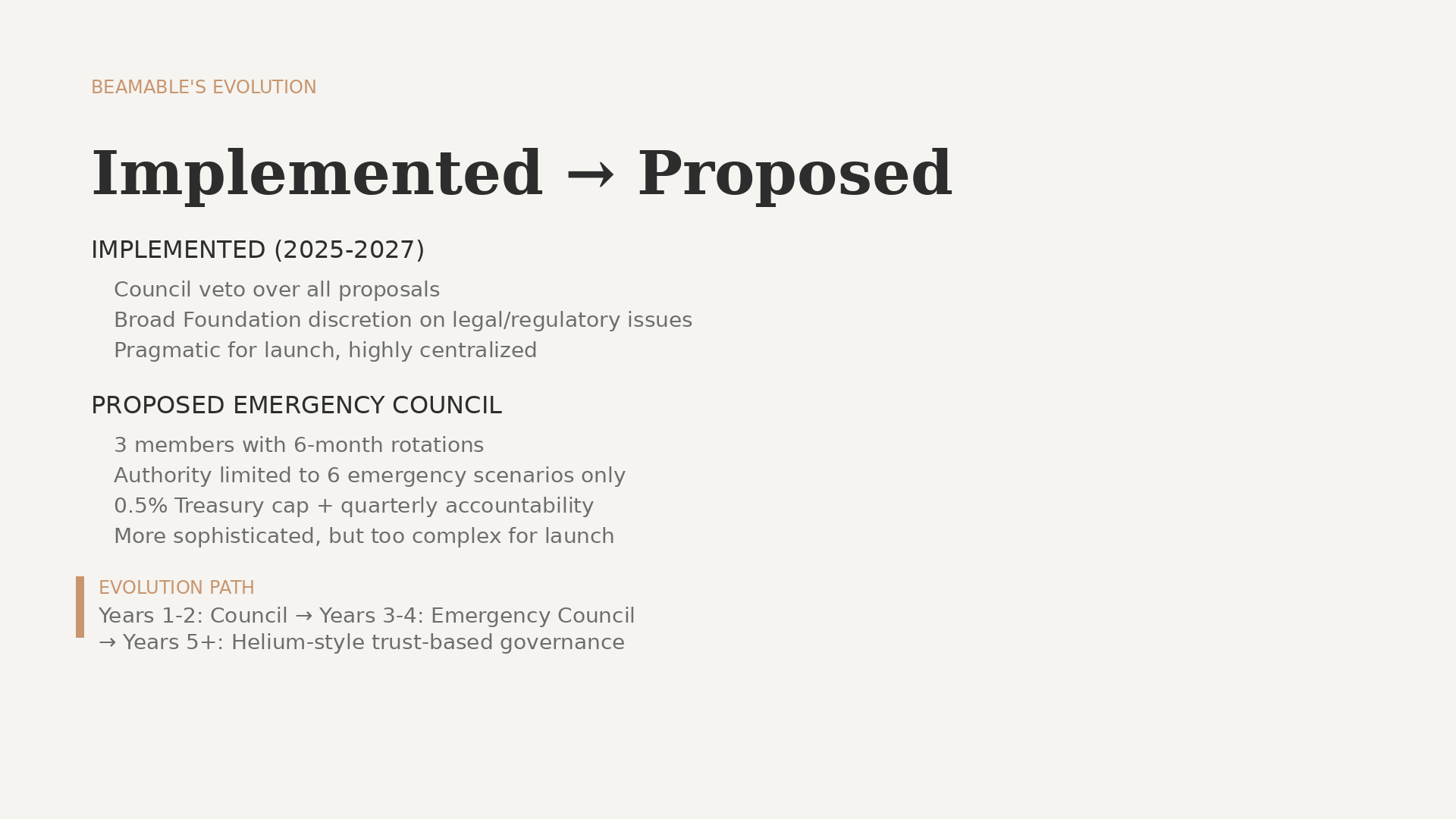
Ad-Hoc Emergency Deployments: Security-critical deployments can be deployed immediately but “must be announced and ratified through subsequent Release Votes”
Protocol Developers as Trusted Actors: Nova Labs, the core development company behind Helium protocol, can deploy emergency fixes, then community votes to ratify in subsequent monthly release
Post-Action Ratification: If community rejects, developers must roll back or modify
Assessment: Helium’s “act now, get permission later” model works because Nova Labs earned community trust over years. The approach provides flexible response to genuine security threats while maintaining accountability through required ratification. However, it relies heavily on Protocol Developer trustworthiness and retrospective approval means community may face fait accompli. This model will likely not work for a new network lacking that established trust relationship.
Akash Network’s Governance Without Emergency Provisions
Akash Network takes perhaps the purest decentralized approach, which notably lacks explicit emergency provisions.
Key Features:
Standard Proposal Process: All proposals go through Github discussions and community feedback period before formal vote
Validator-Driven Governance: Proposals weighted by tokens staked, validators coordinate through working groups and steering committee
Parameter Change Proposals: Can modify protocol parameters without full upgrade, still requires governance vote
No Explicit Emergency Powers: No documented emergency councils, fast-track mechanisms, or security incident protocols
Assessment: Akash represents governance idealism: maximum decentralization with no compromises or trust assumptions beyond validator honesty. However, the absence of any emergency response mechanism is concerning from a security standpoint. With 7+ day voting periods for any change, a zero-day vulnerability could be catastrophic. The reality is that Akash likely handles emergencies through informal validator coordination, not documented because it would undermine the DAO narrative, but necessary for network survival.
Observations: What Works and What Doesn’t
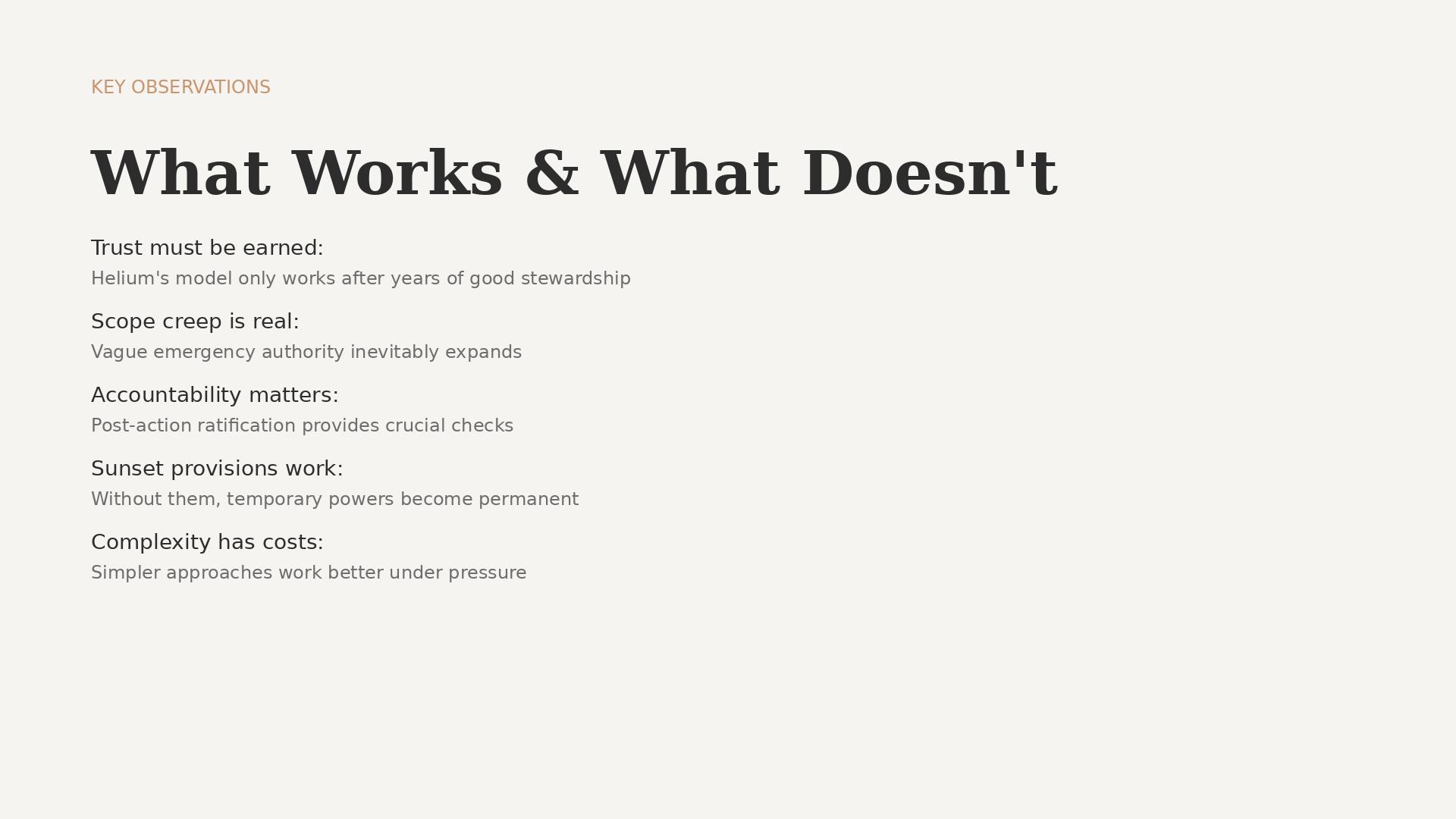
1. Trust Must Be Earned, Not Assumed Helium’s ad-hoc model works because Nova Labs earned community trust over years. A new network like Beamable cannot copy this approach. This is why Beamable’s Council-centric model makes sense initially.
2. Scope Creep is Real Beamable’s broad Foundation discretion could theoretically justify almost anything. The proposed Emergency Council’s six defined scenarios provide better constraints. Without clear boundaries, emergency powers inevitably expand.
3. Post-Action Accountability Matters Helium’s required ratification provides a check on developer power. The proposed Emergency Council’s quarterly reviews serve a similar function. All approaches emphasize on-chain or public disclosure as secret emergency actions destroy community trust.
4. Sunset Provisions Prevent Power Creep Beamable’s 2027 target shows intent to decentralize. The proposed design’s 6-month rotations prevent entrenchment. Without such provisions, temporary powers become permanent.
5. Complexity Has Costs The proposed Emergency Council’s multiple accountability mechanisms are laudable, but would developers in a genuine crisis follow all procedures? Sometimes simpler (if more centralized) approaches work better under pressure.
Recommendations: Designing Effective Emergency Governance
Start Centralized, Plan Decentralization
Accept that early networks need stronger central authority, but set explicit sunset dates. Build progressive decentralization into your roadmap and be transparent about current centralization versus future goals.
Define Emergency Scope Precisely
List specific scenarios requiring emergency response. Set financial caps on emergency spending (0.5 - 1% Treasury per instance is reasonable). Require evidence that situations fit defined emergency criteria. Include an “unknown emergencies” category with mandatory rapid post-action review.
Build Multiple Accountability Layers
Require immediate notification and detailed 24-hour post-action reporting. Implement quarterly community reviews and annual reconfirmation votes. Record all actions on-chain with cryptographic signatures. Never allow secret emergency actions.
Balance Speed with Safeguards
Enable immediate action for security exploits, but require post-action ratification within 7-14 days. Use multisig wallets (2-of-3 or 3-of-5) for emergency funds. Pre-approve certain responses that can be triggered quickly without requiring 4+ hour assembly time.
Rotate Power, Don’t Concentrate It
Implement term limits (6-month rotation is good) with staggered terms. Require geographic/expertise diversity and allow community removal of council members. Never allow indefinite terms or concentrate emergency power in a single individual.
Beamable Network’s Possible Evolution
The case for what was implemented: Simpler to operate during stressful network launch, clearer authority reduces confusion, regulatory safety through broad Foundation discretion, explicit 2027 sunset shows good faith.
The case for evolution: Better constrains power through defined scenarios and spending caps, more accountable through quarterly reviews, rotational membership prevents entrenchment, builds trust by limiting current centralization.
Observation: The implemented approach is pragmatically correct for launch, and evolving toward the proposed model would be directional correct.
Possible evolution path:
Years 1-2 (2025-2026): Current Council Model for network stability during high-risk launch phase
Years 3-4 (2027-2028): Transition to Emergency Council structure with specific emergency scenarios, quarterly accountability reviews, Foundation veto only for legal/regulatory issues
Years 5+ (2029+): Helium-style governance with trusted Protocol Developers, emergency actions with post-action ratification, full community control
This path provides launch stability while moving toward meaningful decentralization faster than the current 2027 target alone would suggest.
Conclusion: Emergency Powers Are About Trust, Not Authority
The fundamental insight from comparing these models: Emergency governance is not primarily about the powers you grant rather, it’s about the trust you build.
Helium can operate with minimal formal emergency provisions because Nova Labs earned community trust through years of good stewardship. Akash can function without documented emergency procedures (though this is risky) because their validator community trusts each other to coordinate informally. Beamable’s implemented Council model works for now because the community understands this is temporary.
Beamable Network’s proposed-but-not-implemented Emergency Council design represents an aspirational middle ground: formal constraints that would make emergency powers trustworthy even without years of established relationships.
For new DePIN networks, the key is finding the right balance between authority (power to act quickly), constraints (limits preventing abuse), accountability (ensuring appropriate use), and evolution (pathways toward decentralization).
There is no perfect model. But the worst model is pretending you’re decentralized when you’re not, or having no emergency response capability when crisis strikes.
Be forthright about your current centralization. Build in strong accountability mechanisms. Set explicit timelines for progressive decentralization. And above all: use emergency powers sparingly, transparently, and always with the community’s long-term interests in mind.
That’s how you design for crisis without centralizing power, not by eliminating emergency authority entirely, but by constraining it, rotating it, reviewing it, and steadily transferring it to the community as trust is earned.
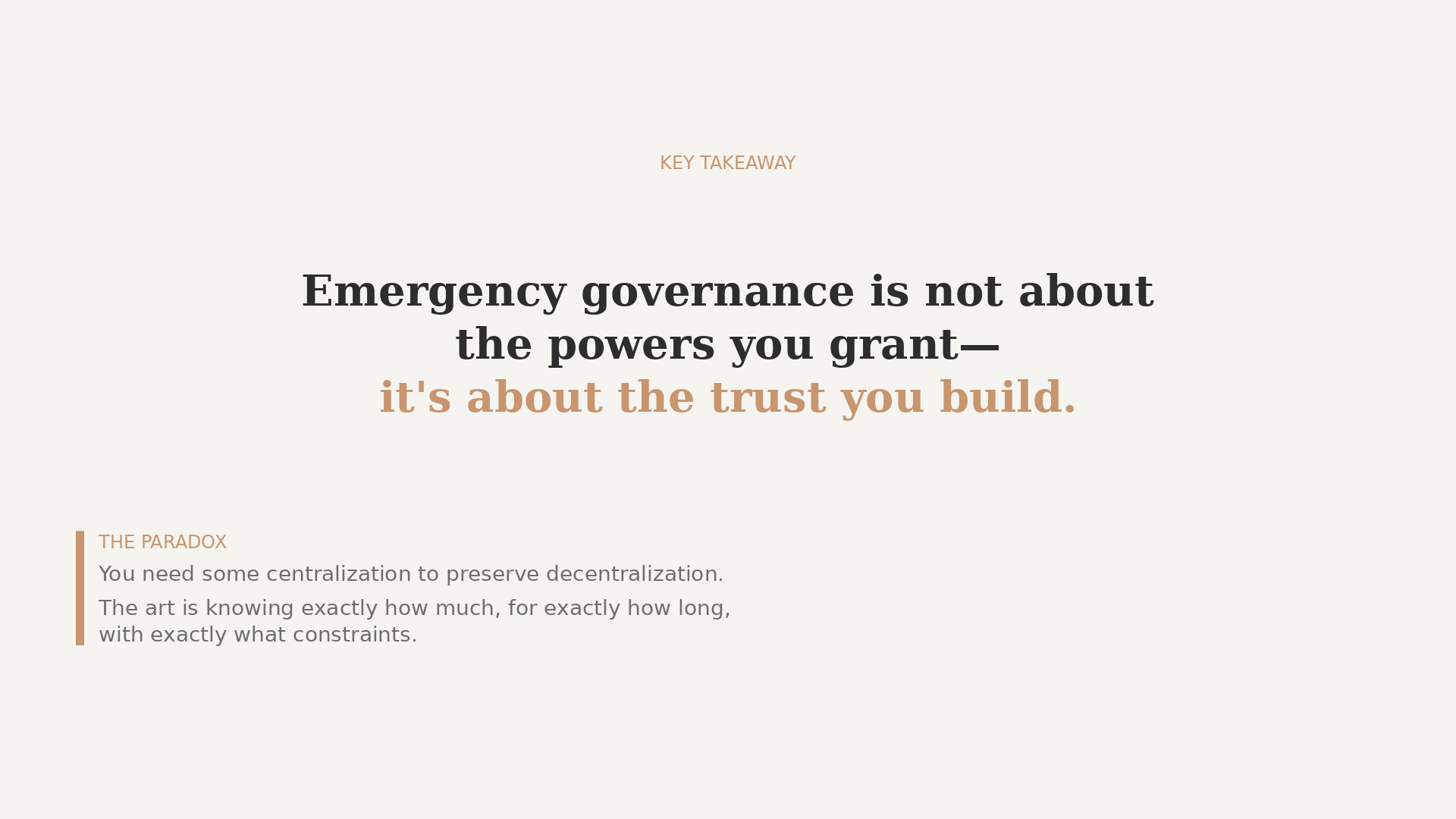
Key Takeaway
Emergency governance is the test of whether your DAO is real or theater. Handle emergencies well with appropriate but constrained authority, and you build trust. Handle them poorly, or not at all, and you risk catastrophic failure or permanent centralization.
The paradox is real: you need some centralization to preserve decentralization. The art is knowing exactly how much, for exactly how long, with exactly what constraints.